Posts filed under ‘memoir’
SEASIDE HEIGHTS: I’LL NEVER RETURN, CONTINUED
You can tell my memories of summers spent on Sumner Avenue in Seaside Heights are fond and cherished. I tried to pass some of that fondness on to my kids – didn’t work.
It was shortly before Easter when I drove my wife and two daughters through the pine barrens of New Jersey to visit Seaside Heights for a weekend to renew my love and establish theirs for this beach town. It had been more than twenty years since I last visited the resort. I expected some change, or course, but was not prepared for the amount of change I discovered. I guess Thomas Wolfe was right. Driving down Sumner Avenue I was stunned. Where were all the bungalows, the salt water toffee selling that traditional costal confection, the bakery where daily we purchased rolls for lunch – all gone? The eccentric guy who lived on the corner of Sumner Avenue across the street from the boardwalk whose overgrown yard was the source of fantastic stories – gone. All replace by an endless parking lot surrounded by loud bars. My mind’s eye could see what was once there, but nothing could be shared with my family other than what was now.
But there was still the boardwalk.
Surprisingly, the boardwalk was more or less as I remembered. It was off-season so the only ride open was the indoor merry-go-round. Of course the penny arcade – gone, replace by mindless video games, no chance to claw-up those precious little false teeth. At least my girls got to play skeeball and watch their prize tickets accumulate to be redeemed for useless junk precious to kids their age.
Driving home, I know my family wondered what the big deal was, while I sought to regain the memories dashed by our pilgrimage, trying to erase the reality of our visit. Now, only the boardwalk anchored my memories of what used to be, and that young boy with his pennies and his dreams of the rewards they would win.
Then Sandy came for a visit and the roller-coaster was ocean-bound and the wheel-of-chance booths blown asunder. Rebuilding slowly accomplished only to be erased by fire.
First, all my memories finding no renewal other than that beloved boardwalk, and then the double dose of destruction visited upon the memorial of my youth. I cannot revisit Seaside Heights. That little boy haunting the boards did not survive fire and flood.
Here are some links where you may purchase my work.
Melange Books
http://www.melange-books.com/authors/walttrizna/index.html
Barnes & Noble.com
http://www.barnesandnoble.com/s/walt-trizna?store=book&keyword=walt+trizna
Amazon.com
http://www.amazon.com/s/ref=nb_sb_noss?url=search-alias%3Dstripbooks&field-keywords=walt+trizna
SEASIDE HEIGHTS: I’LL NEVER RETURN
When I was young, growing up in Newark, New Jersey, a week’s vacation at the shore was rare for our cash-strapped family, but they did occur. When they did take place, it was always at Seaside Heights and always the same bungalow on Sumner Avenue. The event was an extended family affair with my mother’s siblings and always with her oldest sibling, unmarried Auntie Zosia (Polish for Sophie). I have a feeling she contributed a great deal of my family’s share of the cost, she was always helping us out. Perhaps, a future post will be dedicated to Auntie Zosia. She deserves to be remembered.
Another unusual characteristic of our shore vacation was that every night my dad would be handing out cash to us kids to spend while walking the boardwalk while normally little money was available. I think this was Auntie Zosia in action again behind the scenes. Nothing was ever said about the source of this new-found wealth, but that was the way she usually worked.
The bungalow on Sumner Avenue was only half a block from the boardwalk, and because of its close proximity to the ocean, the house was permeated with a constant salt-tinged moistness, not an unpleasant benefit of a life near the ocean.
The week was filled with family bonding and boardwalk adventures. An early morning visit to the beach to claim our piece of sand with an army blanket, in those days everyone had an army blanket, then a patrol exploring the area of the boardwalk under the shooting gallery to harvest the small copper shell casings that would fall through the boards. Why, because we were kids.
The days were spent on the crowded beach with the occasional dip into the frigid ocean jumping the waves. Nights were spent on the boardwalk playing miniature golf and going on rides. The adults would congregate around the spinning wheels of chance hoping to win towels, candy and yes – cigarettes.
Those were also the days of the penny arcade when a pocket full of pennies could entertain you for hours. Investing pennies in claw machines harvesting tiny sets of plastic false teeth along with other plastic junk you kept forever or until your mother cleaned. One of my favorite ways to spend my pennies was at the card machines. For two cents inserted, out would pop a post-card sized picture of a baseball player or airplane, depending on which machine you chose.
Rainy days were not a washout at the shore thanks to the penny arcade. If you wanted to make a slightly larger investment of a nickel, you could play the baseball pinball machine. A steel ball was pitched and the lever you worked was your bat. Depending on your skill, and of course luck, you scored runs. The best part was, as the runs added up, you were rewarded free games. A nickel sometimes brought you an hour’s worth of entertainment if you were ‘hot’ that day.
To be continues…
Here are some links where you may purchase my work.
Melange Books
http://www.melange-books.com/authors/walttrizna/index.html
Barnes & Noble.com
http://www.barnesandnoble.com/s/walt-trizna?store=book&keyword=walt+trizna
Amazon.com
http://www.amazon.com/s/ref=nb_sb_noss?url=search-alias%3Dstripbooks&field-keywords=walt+trizna
THE DAY KENNEDY DIED
With this being the anniversary of the Kennedy assassination, I thought I’d re-blog a post i made some time ago.
November is the month of thanksgiving, when the weather no longer bounces between summer and winter, when the chill of fall sets in with a vengeance preparing us for the hard cold of winter. It is also the month John F. Kennedy died at the hands of an assassin.
During November 1963 I was a junior at East Side High School. I already had a deep interest in science and forfeited my study hall to work in the school biology lab. I designed an experiment to study Medallion heredity. The experiment required two black and two white mice, which I purchased, and began mating the mice in all the various combinations possible, trying to predict the color of the littermates. I soon ran out of space in the cellar where I was keeping my mouse colony and asked permission to move my many mice to school I pressed on, until I began seeing litters with brown siblings, something I had not anticipated. This brought an end to my experiment and an introduction to the unpredictability of science.
It was while I was working in the school lab one November Friday afternoon that someone came in and said that the president had been shot. I recall reacting to the news with horror and disbelief. The emotions of I felt will always stay with me, the sense of experiencing a moment that defied all logic, the vitality of our young president in jeopardy. I sensed that the world had changed; this quiet November afternoon would become a milestone in history. All I knew was that the president had been shot; there was still hope of survival as I headed home from school that day. But as I walked the mile and a half home from school, I saw something I shall never forget, something that dimmed my hope. On my way, I saw clusters of people standing on corners and most were crying. The residents of Newark are not known for their emotional displays so this sight was disturbing. It was the first signal I had that something was extremely wrong, that the world had changed, and not for the better.
When I reached home, my father was already there, not unusual for he began work early in the morning and was home before me most of the time. I would find him sitting in the kitchen with his beer and paper, but today he was in the parlor watching the TV and he was crying too, something I recalled seeing only once before. The last time I saw my father cry was when my mother lost a baby girl shortly after birth. Ironically, my sister died almost the same time the Kennedy’s lost their third child and also for the same reason, underdeveloped lungs. As my father sat weeping before the TV, he told me that the president had died.
The days that followed were surreal. Long before the age of cable and satellite dishes, there were only three major networks and a few independent New York stations broadcasting to Newark. All normal broadcasting ceased; TV carried nothing but news and insight into the assassination. On the radio, all normal programming came to a halt. The radio played nothing but somber music and news of the assassination. Everyone watched the news all weekend, watching history unfold before our eyes. Shortly after Kennedy died, Oswald was captured. The nation viewed live, the instrument of their sorrow. We watched Oswald’s murder at the hands of Jack Ruby, adding confusion on top of the misery. Everyone’s thoughts were in turmoil as these historic events concluded with JFK Jr. saluting his father’s casket.
The day Kennedy died; I learned something of the unpredictability of life.
MY FARMER DAUGHTER: ANOTHER VIDEO
Bear with me as I play the role of ‘proud dad’, for I am.
Attached is another video about Lynn’s work on the farm. I find it so interesting that this kid from Newark, New Jersey has raised a farmer.
From Farm to Patient: How One Medical Facility is Rethinking Hospital Food
I’ve also reposted a memoir piece of my childhood gardening experience.
You might say agriculture is in our roots. (Ha, Ha)
MEMOIR
GARDENING
I have always been amazed at the resilience of plants. There are those you can abuse and they come back stronger than ever. My small garden in Newark, New Jersey did not endure the harsh treatment I unknowingly subjected it to. But I enjoyed that patch of green and my small connection to nature.
Have you ever stopped for a red light while driving and gazed over at the concrete median and there, against all odds, growing through a tiny flaw in the concrete is a plant? I am amazed to see how life persists even under the most adverse conditions. As a child in Newark I simulated those exact conditions, although I called it gardening.
The yard we had on Christie Street was actually quite large. Large enough to have kickball and baseball games, but then again, we were quite small. Once I was older, we would have barbecues on our charcoal grill, summer nights spent sitting on beach chairs on the hard-packed soil, enjoying burgers and hot dogs as we listening to the sound of the city as night closed the day.
Next to our house was the landlord’s house, which was a small two story one family dwelling with and alley running between the two houses. Behind the landlord’s house was a garden, fenced in. On the opposite side of this small house was a driveway, which was actually quite long, and when I was old enough to shovel snow, it seemed to become longer still.
Our yard was large enough to hold a couple of cars, with some scraggly patches of grass growing defiantly, despite the conditions. To the rear of the yard was a three-car garage, one of which my father rented, and this was the reason I was given the opportunity to shovel the driveway. Next to the garages, and beyond the area of the yard where we were permitted to play, was another fenced area where the residents were not allowed. An old glider swing back there, but nothing much more. At the edge of this restricted area was another small fenced space, about six feet by six feet, sheltering a small garden belonging to the old woman across the hall. She had mostly zinnias and marigolds and it was a great place to catch whatever butterflies found their way into our yard. I admired her garden. She was always out there tending her flowers, pulling weeds, tying up plants with wooden stake and old stockings, the traditional way of supporting tall plants back then.
One day the fence bordering the back of the yard came down and that area of the yard was no longer restricted. I’m not sure why the fence came down. The glider swing came down about the same time. Now a whole new area of the yard was available, an area perfect for a garden. With our landlady’s permission, my sisters and I started construction
The ground was as hard as concrete; there was a total lack of anything that resembled topsoil. So off we went in the old Chevy for some rich loam. We traveled a short distance to where my grandparents lived in Hillside. There was a little-used park along a stream not far from their house, and that is where we headed for our soil. We parked as close as we could and, armed with a shovel and several large containers, started digging up the bank of the stream.
Once our topsoil was obtained, my sisters and I framed out small areas. We each had an area about twenty to twenty-five square feet backing up to the fence separating our yard from the neighbor’s yard. We made a feeble attempt to turn the soil before adding the topsoil, but the product of our digging was only reddish soil and rock, so we dumped our topsoil on top of our little garden areas and started planting.
I was rather ambitious when I planted my garden. I bought tomato and pepper plants, planted carrot, beet and parsley seeds all in neat little rows. These poor plants and seeds did less than thrive. I grew everything in miniature. My beefsteak tomatoes were more like their cherry cousins, the plants barely needing any support at all. My peppers were the size of plums. And my carrots – I grew those tiny carrots that they feature in seed catalogs, ones as big as your pinky, but I in fact was going for the full-sized edition. Why I attempted to grow root crops in concrete-like soil is a mystery to me now. But I was proud of my little garden. When my sisters lost interest, the size of my garden grew. I watered and weeded the few limp weeds that dare take up residence amongst my crops and generally enjoyed the little area of green I had created out back.
Then one summer it happened, a true sign that I had truly established a growing zone in Newark, I was infested with insects. The leaves on my plants were full of holes. This phenomenon amazes me to this day. How you can grow a plant that is unknown to the area, yet an insect that specifically attacks that plant will find and destroy it. And so it went for my little plot in Newark. I purchased a powder that I thought might remedy the situation, and after a heavy dusting that left my plants white under the strong mid afternoon sun I read the directions. This pesticide was to be applied lightly and only during the cool of the evening, always avoiding exposing the plants to this killer during the heat of the afternoon. By nightfall, my whole garden was withered and dead. I eliminated my insect infestation and in the process eliminated my garden.
The next year I planted again with a new knowledge of pesticide use. I branched out to flowers, planting some morning glories in a corner of the yard near my garden, another small square of the yard taken over for horticulture.
I have my own yard now, much larger than the yard of my youth. I enjoy my vegetable garden and the flowers planted around the property, but there are days when I think back to my little plot in Newark where I teased life from the concrete soil.
OUR BIRDFEEDER DRAWS A CROWD
It may be time to upgrade our squirrel-proof birdfeeder after this new challenge by the masked intruder.
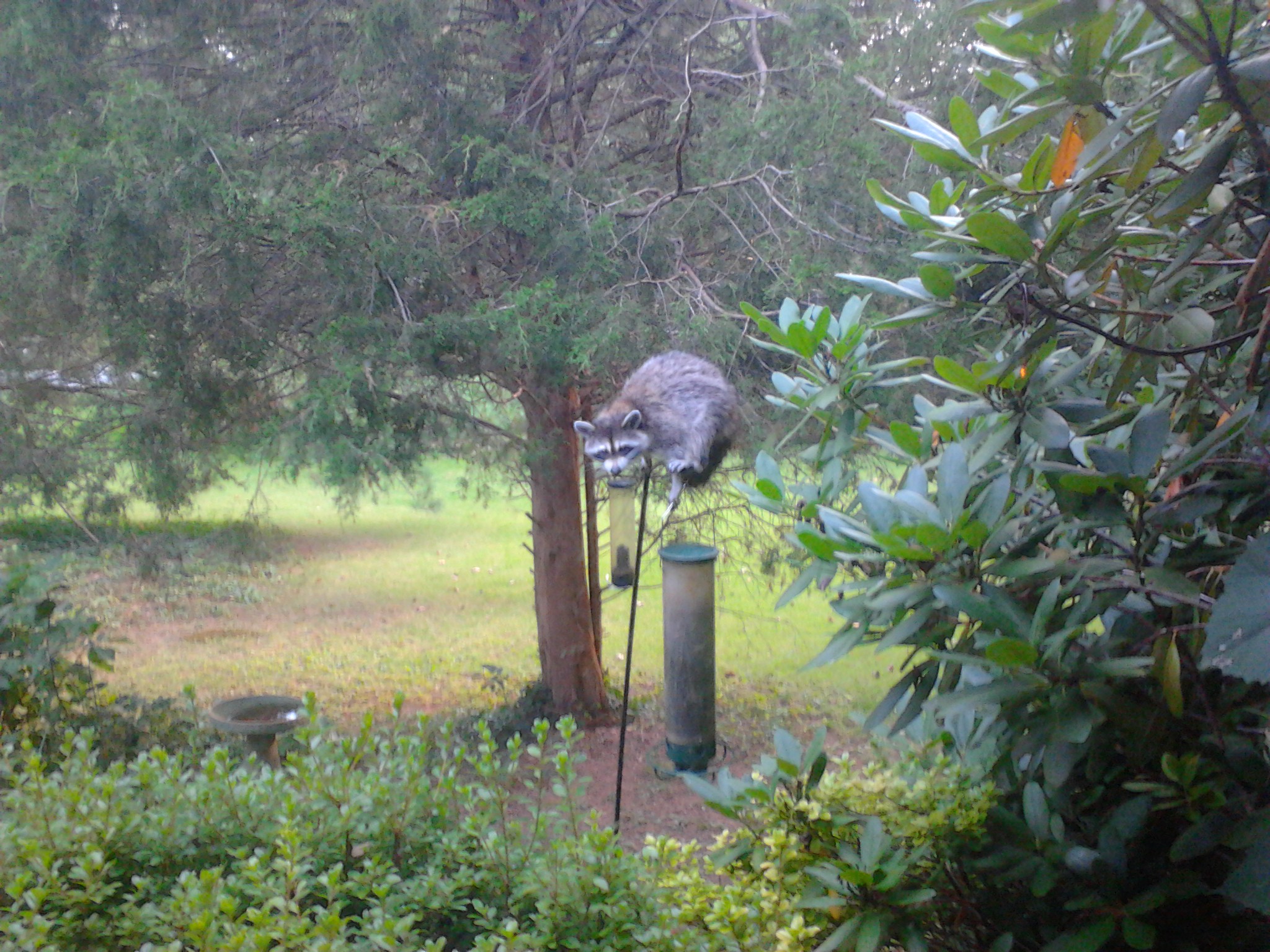
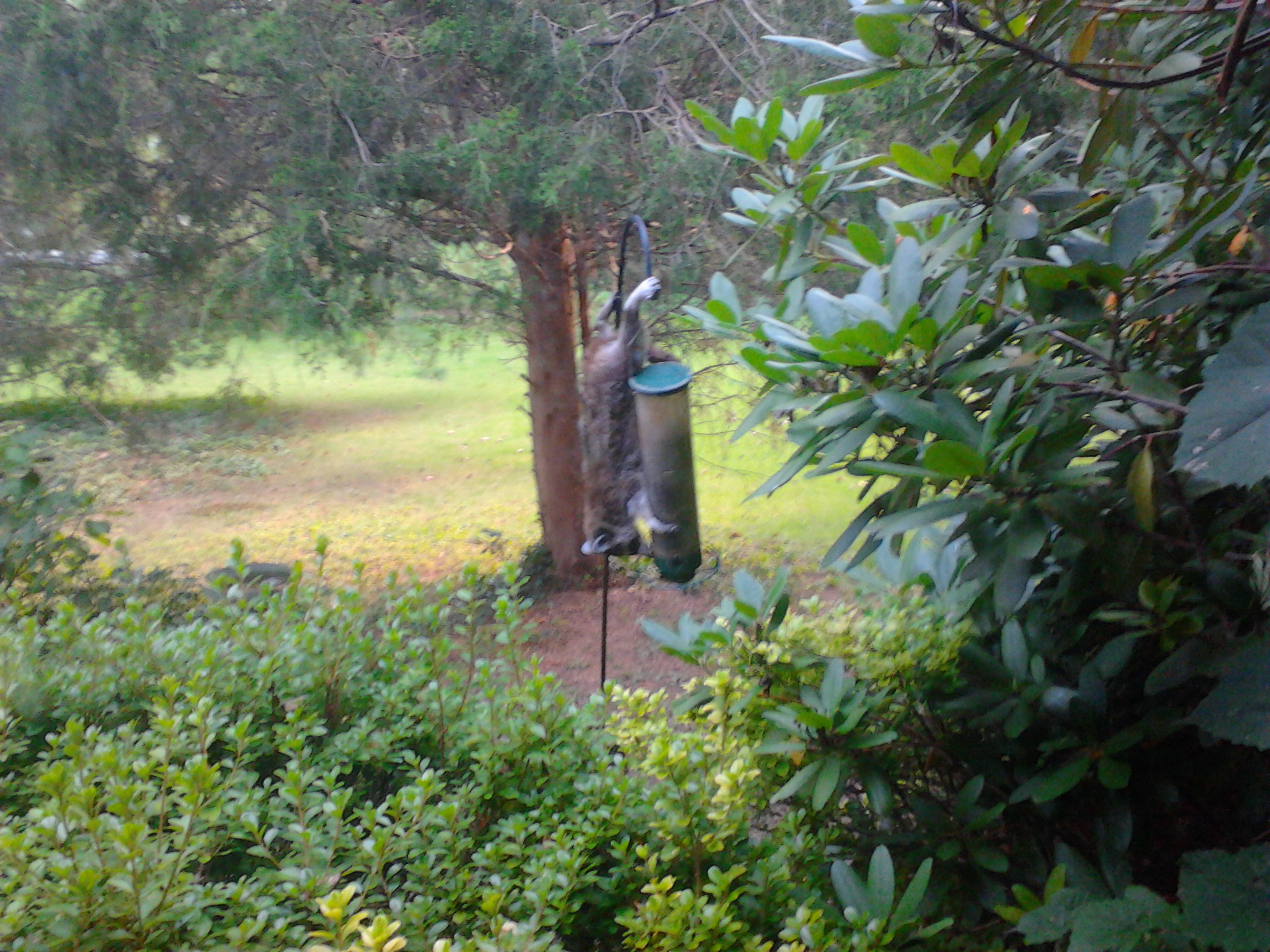
Believe it or not, this is in a sense, a memoir piece.
We live a suburban life where homes occupy half-acre lots. Not far from home are fields of corn and stands of forest. Our piece of land is bordered by a gully, once the home of railroad tracks. Overgrown now, it is a natural highway for wildlife.
Groundhogs and fox have made dens in the gully’s confines. The groundhogs can be seen lumbering around the front and back yards, or heading towards my garden. Foxes can be heard more than seen, although on winter afternoon I caught the sight of a red fox against a new snow. Summer nights they call, to one another or pierce the tranquility with a rabbit kill. In recent years, deer have appeared in the gully, up to five does occasionally accompanied by a buck, a sure sign of the species overpopulation in the area. Also, a sign of danger for our road is a busy one. Skunks are around, but see almost never only smelled.
The birdfeeder pictured attracts a host of birds, chickadees, cardinals, titmouse, goldfinches and the occasional woodpecker. Now, for two day running the sunflower seeds have also attracted our masked visitor.
“How is this a memoir piece?” those of you still with me are probably asking. The observations above reinforce in me the memories and contrast in my mind my present conditions and those I experienced while growing up in Newark, NJ. When looking out on the tranquil area I call home, I recall our backyard in Newark, dirt and cinder, defying the growth of grass. Our wildlife consisted entirely of squirrels. Our birds were limited to sparrows and starlings, with the occasional robin looking forlorn and confused. Those distant memories help me appreciate the surroundings I inhabit now, help me appreciate my Pennsylvania home.
Some future day, I hope to spend part of the year near the ocean. Its vastness provides a ceaseless source of peace and contemplation. I could never live on its shore year-round, for I fear that that endless body of water would become commonplace and lose its magic. My Newark youth provides no problem in keeping the wonders of nature in prospective.
MEMOIR: LIVING ON BORROWED TIME
I’m old enough, and my memory good enough to recall a great deal of detail growing up in Newark, NJ during the 1950s and 60s. With these memories in mind, I study the world around me and have to chuckle. At times, it’s as if our society is rediscovering the wheel, then again, at times I’m amazed that my wheel still turns.
One observation which I find interesting is the current nutritional trends, and what information they provide – if any. Consider all the studies you’ve heard concerning the benefits or harmful effects of coffee consumption. I don’t know about you, but it boggles my mind. Some of the current nutritional mindsets are to cut down on processed food and eat local. When I was young, we adhered to these principles as a way of life. Processed food was in its infancy. And unlike today, for better or for worse, the mom of the family stayed home. Most did not know how to drive, and that didn’t matter because most families could only afford one car. Few moms worked outside the home. Their lives were taken up with raising the kids, maintaining the home and cooking. We are warned away from processed and junk food, yet grocery store shelves grow heavier and heavier with these items. Is there a bottom line at work here?
Another ‘new’ trend encouraged is to eat locally. While I was growing up that was the only option. Fruit and vegetables – veggies had not been invented yet – were not transported from all over the globe as they are now. In my neighborhood, fresh produce was available during the summer months sold from a horse-drawn wagon. During the winter the stores carried a minimal selection.
Those are the positives of my past which are far outweighed by the negatives, hence to purpose of this article.
During my youth, the fear of cholesterol was unknown. Of course it existed, but knowledge of its hazards was unknown and its effect, insidious. Food was consumed without a thought to sodium or fat content. Taste was all that mattered. It was a time long before the existence of ‘best by date’. The rule of thumb was: If the can wasn’t swollen the contents were fine to consume.
But all this is secondary to the primary reason I am living on borrowed time, although my food consumption has left its effects in the form of bypass surgery. The health concern most abused in my past was sun exposure. Today we have sunblock able to protect you from any damage the sun may try to deliver. When I was a kid we also had a means of protection and it was homemade. This was long before billboards began displaying that cute little girl having her bathing suit bottom pulled down by that delightful dog to expose her pale butt and tan line.
The means I used to shield myself from the sun’s harmful rays was a concoction of a few drops of iodine dispersed in baby oil. Where that was invented I have no idea. Did it work? No way! Every summer’s journey to the shore resulted in a bright red burn resulting in a mass of oozing blisters. Back then we were of the mindset that when you spent a day at the shore you had to get your money’s worth and we always paid the price. When we went as a family unit, on the way home I and my siblings would sit in the backseat of the old Chevy shivering from the intense sunburn. To this day we fondly refer to those sun-induced chills as suffering from ‘the disease’.
Once home, my mom would apply vinegar to our burned bodies. This remedy is actually documented as working, usually in vinegar ads. At night, after a day at the beach, slathered in oil and vinegar we were human salads suffering the pain of a summer outing.
MEMOIR: PRESERVING YOUR PERSONAL HISTORY
While thinking about and writing my memoir, I have come to the realization it is to share our history with our families, to put down the words of our lives. Our lives, to varying degrees, help form the world around us be that world distant or immediate.
As a youth of perhaps ten, I recall sitting in our backyard one summer day when our neighbor came out. The couple living next door was an elderly Polish couple. The husband rarely left the flat, so seeing him outside was a rarity. While he stood there, much to my surprise, he began talking about World War I, how he recalled airplanes flying overhead. With my love for aircraft, I was immediately enthralled. If I had been thinking, I should have sought every memory he had of the war. I never knew if he served during the conflict, and if he did, on which side he fought. I asked no questions, but 50 years later I still can recall that conversation. That fact is testament to my lost opportunity.
The same is true with my parents. My dad was in the army in 1941, with his service almost completed. He told me that when Pearl Harbor was attacked by the Japanese, he cried, for he knew then he would probably be in for the duration and he was right.
While my wife and I were living in Los Angeles, he came for a visit. Long Beach, CA was the home of the Queen Mary and we took him to tour the vessel. I wanted to make the pilgrimage for I knew he traveled from the U.S. to England on that ship. I’m sure he never expected to walk its decks again. During World War II he served in a supply unit and travel through Africa and then Italy. He did not see action and was strafed once while on a train by a P-51, one of our fighters – oops.
He didn’t talk about the war much and I didn’t ask; my loss.
The greatest regret I have about missing a personal glimpse into the past was talking to my mom about her life when she was young. She lived through the Great Depression and observed conditions on the home front during World War II and I never asked was life was like during those times.
For those of you who read this blog, do not make the mistake I did. Ask your senior citizens about their past. They have a more vivid experience with history than a book can provide.
MEMOIR: LIFE ON A SHOESTRING
Once, while listening to NPR, I heard a report on credit cards. The report stated that the average person has thirteen credit cards and carries about eight thousand dollars in debt. This was some time ago; I hope the numbers have improved. I must admit, that there are times when I have trouble getting my wallet in my back pocket because of all the potential debt lingering in there, but try to keep it under control. On hearing this broadcast, my mind wandered back to my youth, a time when people had the mindset that it was not so much that you lived without but you lived with what they could afford. It was a time less of envy and more of survival.
For most of my youth, credit cards did not exist. They started flourishing in the 60’s, so when I was young, they were not even an option. For paying bills, my parents didn’t have a checking account. When there was a bill that needed to be paid I was sent to the drugstore to buy a money order. It was the only way my family sent money through the mail.
In my neighborhood, credit was not as much a way of life as it is today. People lived on what they could afford. With the exception of houses and cars, you bought what you could pay for then and there. I must admit just writing about life without credit seems so foreign and unreal. Buying just what you can afford at the time of purchase seems like such and odd concept, yet that is the way it once was.
The way a person received their pay was also different in my youth. Friday afternoons, my dad was home from working at the tannery for hours, but he had to return Friday afternoons to get his pay. I would sometimes take a ride with him. You could smell his place of employment long before you could see it – Ocean Leather – gaining this name due to the fact that it was the only tannery at that time that could tan shark skins. We would drive around to the loading dock where drums of chemicals stood, the soil, stained shades of purple and green, was soil of an OSHA nightmare. Into the building we would go, past large rooms where various stages of tanning was taking place, and into the office. Here my dad was handed a brown envelope with bills and change and that was his pay. That’s the way people were paid back then, you actually held your pay in your hand. It was not electronically sent to your bank from which you electronically paid your bills. You were able to hold what you earned, actually see it.
Friday was also allowance day for me. For completing my choirs, I received fifty cents a week, and when I could really control my spending – not wanting another airplane model or book – I turned those quarters into a dollar bill, real folding money, which I would immediately take to the cellar and hide – I don’t know why. To this day I can still recall the feeling that, with a quarter, I had money. With a quarter in my pocket, I’m okay. How things have changed, and how I remain the same. It doesn’t take much to make me happy.
During my younger days I remember my dad saying, “Always keep two dollars in my wallet or else I could be arrested for vagrancy. If the police only knew how often I walk around with an empty wallet these days I could easily wind up behind bars, aha, but there is the MAC card and all my other credit cards with their lines of credit that keep me out of jail but could lead to the poorhouse.
MEMOIR: HIKING SOJOURN
In the scouts for years, I journeyed from Cub Scout to Boy Scout to Explorer earning the Eagle Scout award along the way, learned and explored many things a city boy would not normally encounter. One of the activities I enjoyed the most was the opportunity to go camping.
An hour’s drive northwest of Newark, New Jersey near Boonton was a Boy Scout campground. My troop would camp there several times a year, mostly in the winter. Cabins of various sizes dotted the campground. The only source of heat was a fireplace at one end of the cabin and cooking was done on a wood-burning stove. One winter, we had to melt ice for water. The weather had been so cold that the pipes to the old hand pump had burst. It seemed the harsher the conditions; the more we enjoyed the outing. City boys were facing nature head on.
On my first experience camping at the campground, we boys were going to cook a spaghetti dinner for Saturday night. The scout master wasn’t there, and none of us had ever cooked spaghetti before, but that didn’t stop us. We filled a large pot with water, put in the pasta and set it on the wood-burning stove to cook. A couple hours later we had one large noodle. That’s how I learned you needed boiling water to cook pasta.
The camping trips were formal outings organized by the troop. The less formal day hikes to the local Boy Scout area located in the South Orange Mountain Reservation, would be organized spontaneously, when a group of us were just hanging around with nothing to do. For a group of boys ranging from maybe eleven to thirteen, these trips were a real adventure. The beauty of these outings was that the city bus could take us to the base of the mountains. No adult input was required, once permission to go was obtained.
We usually caught the bus fairly early in the morning because once we arrived at the base of the mountain; it was at least an hour walk to the Boy Scout area. Sitting amongst commuters going to work or out to do some shopping, laden with packs and canteens and any other camping paraphernalia we thought we might need, we proudly displayed our badge of ruggedness. We rode through the Newark downtown area, then north through some of the blighted areas of the city, and then on to the more affluent suburbs. The bus would leave us in the shopping district of South Orange, where we would start to trudge up the hill to what us city boys considered wilderness. We hiked past stately homes with manicured lawns, a far cry from our homes in Newark. Finally, the houses were replaced with trees and the sidewalks with a dirt shoulder – we were almost there.
Our destination lay down a dirt road branching from the main highway. The area was large and open, set aside for day-tripping scouts to build fires and cook their meals. Across a stream bordering the area and up into the trees stood a few cabins for weekend outings. The cooking area was supplied with a generous amount of wood provided by work crews maintaining the reserve. For a bunch of boys who thought starting a charcoal fire was an adventure – this was nirvana.
Lunch was usually hot dogs and foil-wrapped potatoes and onions. The fire built to prepare these meager meals was immense to say the least. On hot summer days, we built fires large enough to heat the whole area during the dead of winter. Once everyone tired of throwing on wood, we had a fire too hot to approach to do any cooking. Either you waited for the flames to die down or had to find a very long stick to cook your hot dogs.
After our meals were consumed and the fire extinguished (I won’t go into how we boys would sometime extinguish fires), we set off on our hike. The mountain reservation was extensive with a variety of trails we could wander. Some were relatively flat, along a streambed, while others were more strenuous. One hike we often took was up a steep hill with the final climb to the summit a rock face. A spectacular view awaited, a view city boys could appreciate. When we later returned to the Boy Scout area, we usually built another fire whether on not we had anything to cook. With everyone rested, we began our trek down the hill to catch the bus home. Somehow the walk down always seemed longer than the walk up. By now we were all grungy and reeked with the smell of smoke, but we always enjoyed each other’s company and the time we had in the woods. After once again walking through affluence, we boarded the bus and made our way past the slums of Newark and finally to our homes. I treasured these outings with friends and took comfort in the fact that the solitude of a forest was only a bus ride away.
 Walttriznastories's Blog