MEMOIR: HIKING SOJOURN
In the scouts for years, I journeyed from Cub Scout to Boy Scout to Explorer earning the Eagle Scout award along the way, learned and explored many things a city boy would not normally encounter. One of the activities I enjoyed the most was the opportunity to go camping.
An hour’s drive northwest of Newark, New Jersey near Boonton was a Boy Scout campground. My troop would camp there several times a year, mostly in the winter. Cabins of various sizes dotted the campground. The only source of heat was a fireplace at one end of the cabin and cooking was done on a wood-burning stove. One winter, we had to melt ice for water. The weather had been so cold that the pipes to the old hand pump had burst. It seemed the harsher the conditions; the more we enjoyed the outing. City boys were facing nature head on.
On my first experience camping at the campground, we boys were going to cook a spaghetti dinner for Saturday night. The scout master wasn’t there, and none of us had ever cooked spaghetti before, but that didn’t stop us. We filled a large pot with water, put in the pasta and set it on the wood-burning stove to cook. A couple hours later we had one large noodle. That’s how I learned you needed boiling water to cook pasta.
The camping trips were formal outings organized by the troop. The less formal day hikes to the local Boy Scout area located in the South Orange Mountain Reservation, would be organized spontaneously, when a group of us were just hanging around with nothing to do. For a group of boys ranging from maybe eleven to thirteen, these trips were a real adventure. The beauty of these outings was that the city bus could take us to the base of the mountains. No adult input was required, once permission to go was obtained.
We usually caught the bus fairly early in the morning because once we arrived at the base of the mountain; it was at least an hour walk to the Boy Scout area. Sitting amongst commuters going to work or out to do some shopping, laden with packs and canteens and any other camping paraphernalia we thought we might need, we proudly displayed our badge of ruggedness. We rode through the Newark downtown area, then north through some of the blighted areas of the city, and then on to the more affluent suburbs. The bus would leave us in the shopping district of South Orange, where we would start to trudge up the hill to what us city boys considered wilderness. We hiked past stately homes with manicured lawns, a far cry from our homes in Newark. Finally, the houses were replaced with trees and the sidewalks with a dirt shoulder – we were almost there.
Our destination lay down a dirt road branching from the main highway. The area was large and open, set aside for day-tripping scouts to build fires and cook their meals. Across a stream bordering the area and up into the trees stood a few cabins for weekend outings. The cooking area was supplied with a generous amount of wood provided by work crews maintaining the reserve. For a bunch of boys who thought starting a charcoal fire was an adventure – this was nirvana.
Lunch was usually hot dogs and foil-wrapped potatoes and onions. The fire built to prepare these meager meals was immense to say the least. On hot summer days, we built fires large enough to heat the whole area during the dead of winter. Once everyone tired of throwing on wood, we had a fire too hot to approach to do any cooking. Either you waited for the flames to die down or had to find a very long stick to cook your hot dogs.
After our meals were consumed and the fire extinguished (I won’t go into how we boys would sometime extinguish fires), we set off on our hike. The mountain reservation was extensive with a variety of trails we could wander. Some were relatively flat, along a streambed, while others were more strenuous. One hike we often took was up a steep hill with the final climb to the summit a rock face. A spectacular view awaited, a view city boys could appreciate. When we later returned to the Boy Scout area, we usually built another fire whether on not we had anything to cook. With everyone rested, we began our trek down the hill to catch the bus home. Somehow the walk down always seemed longer than the walk up. By now we were all grungy and reeked with the smell of smoke, but we always enjoyed each other’s company and the time we had in the woods. After once again walking through affluence, we boarded the bus and made our way past the slums of Newark and finally to our homes. I treasured these outings with friends and took comfort in the fact that the solitude of a forest was only a bus ride away.
NEED A BEACH READ?
Need that book for the beach you won’t be able to put down?
Give New Moon Rising a try!
Here’s a taste.
Chapter Twenty-Two
Pasadena
A phone ringing in the early morning hours is seldom a harbinger of good news. When Wade’s phone rang at two thirty-five in the morning, he came out of a peaceful sleep and with dread, reached for the receiver.
“Wade, this is Jeff at the lab.” The excitement in the young graduate student’s voice spoke of disaster before he revealed the reason for his early morning call. “It may have started. We have seismic activity along the whole Hawaiian chain. We have earthquake activity measuring 8.6 on the Richter scale. It’s the strangest earthquake, associated with the islands, anyone here has seen. The earthquake occurred at 4:20PM Hawaiian time. We cannot pinpoint the origin. It’s a series of earthquakes occurring simultaneously beneath the whole island chain. There have already been reports of tsunamis from Midway Island, the Marshall Islands, and the Samoan Islands. New Zealand, Australia, Central America, and China are all bracing for a giant wave. No one knows if the tsunami will be as bad as 2004.”
Jeff responded, “This is amazing! Earthquakes like this have never been described before. No one will know what to expect.”
“Jeff, try to calm down. Juliet and I will be at the lab as soon as we can.
Have the proper authorities been notified?”
“Are you kidding? Every lab in the world recorded this event. Damage reports are already coming in from Hawaii and the damage is widespread.”
“We are also getting signs of volcanic activity around the dormant volcano you instrumented on the island of Hawaii. There have been reports of ash spewing from several volcanoes on some of the islands that haven’t had activity for hundreds, or in some cases, thousands of years.
Wade’s thoughts instantly went to Foster on Oahu. “Is there any report of activity of Oahu?”
“Koolau volcano on Oahu is reported to be putting out ash and smoke.” Wade finished by saying, “We’re on our way, Jeff.”
Wade tried to control his own emotions as he turned toward Juliet. She had propped up her pillow and was listening to the conversation. Just from hearing Wade’s end, she knew that the news was not good.
With fear in his voice, he said, “It looks like it’s begun.” He went on to tell her all that he knew from Jeff as they hurriedly dressed and set out for the lab.
As they approached the Geology Building, every window was illuminated. Wade noticed that the parking lot was already half full as they pulled into his
organized and assigned specific tasks.
A group was told to keep track of earthquake damage and aftershocks. Another was told to track tsunamis, and a third group was told to monitor the Hawaiian Islands for volcanic activity. Constant contact was established with labs in Australia, New Zealand and their colleagues in Japan. There was an attempt made to contact the lab in Hilo at the University of Hawaii—but the lines were out.
With all the phones and computers manned, order began to emerge from the chaos. Wade had a chance to inspect the seismic tracings from the earthquake beneath the Hawaiian Islands. They represented not a single quake, but a long series of overlapping quakes. The location was difficult to determine. The earthquakes occurred at a series of points beneath the Pacific Ocean surrounding the Hawaiian Islands. The character of these quakes fit into the scenario along with the other events that occurred, supporting Professor Humphries’ theory. They were unprecedented in modern time.
Wade stood in the lab, holding the tracings, and wondered about his brother and all the rest of the population of Hawaii, people in love with their paradise. So in love were the residents, that it may have cost countless lives to enjoy heaven on Earth just a little longer.
* * * *
Oahu
Foster continued to work at the surf shop and Heather at the bed and breakfast although each had little to do. Heather took her baby to work with her and found time to feed and care for him while she accomplished her tasks. The working conditions were ideal for caring for the baby. In fact, Lulu gave him so much attention, that if it weren’t for the fact Heather was breast-feeding; he would need no care at all.
Although life went on, there was a pall hanging over the islands knowing that its days might be numbered. Foster had become close friends with most of the surfers who congregated on the beach and shopped at the store. A few that were originally from the mainland returned home but all the native surfers chose to stay. For the most part, they were young men who loved the surf and sun and little else. When asked about their future, almost to a man, they talked about quality of life—not quantity.
Foster was working behind the counter one day while Joe was grabbing some lunch when his friend Rich Loana entered the shop.
“What can I do for you, Rich?”
“Just wanted to see if you’d be interested in doing some surfing later this afternoon. The waves are supposed to be great today.”
“I should be able to get away around four. I’ll meet you on the beach in back of the shop.”
“Sounds like a plan, Foster. I’ll see you then.”
After Rich left, Foster thought about a conversation he had with Rich months earlier, when the news of what might happen to Hawaii was released.
He had had similar conversations with a lot of the surfers he had gotten to know. One conversation with Rich stuck in his mind.
He’d asked Rich, “What will you do now, Rich?” “What do you mean—I’m going to surf.”
“No, you know what I’m talking about. When are you leaving?” “I’m not.”
“You can’t stay here, it’s not safe.”
“Listen Foster, I was born on this island, it’s my home, the only place I’ve ever lived. And surfing is the only thing I know how to do. I don’t have an education. I don’t have a skill. If I moved to the mainland, what would I do? I’d be a bum the rest of my life. I’m a bum here, but at least I have a chance to do what I love. If this theory is wrong – no harm done. If its right, I’ll be doing what I love doing right to the end.”
Foster found that most of the native-born Hawaiian surfers he talked to had a similar attitude. They were determined to embrace their ‘hang loose’ attitude of life right to the end.
* * * *
Traffic through the shop was light, had been for months. Three-thirty arrived and Foster told Joe he was thinking of riding some waves until Heather came home. “I don’t think I’ll be able to handle this crowd all alone,” Joe said as he looked around the empty store. “Go ahead; get your butt on the beach.”
Foster got a couple good rides before Rich showed up. They rode together for a while until Rich caught a wave that Foster missed. Foster paddled back out to deeper water turned toward the beach and was preparing to get up on his board
It was 4:20.
He could see Rich on the beach taking a breather, when his friend suddenly fell to the sand. Foster thought to himself, “What the hell is he doing now?” Then he noticed branches falling from the palm trees. In quick succession, the roof of the shop caved in leaving a pile of rubble where the shop and apartment had been. He quickly paddled to shore, and as soon as his feet made contact with the sand, he fell to his knees in the shallow water. He looked up and down the beach and the few people still standing were holding onto a tree or other stabilizing object with looks of shock and disbelief on their faces.
The trembling lasted minutes, but it seemed like hours. Time slowed as the Earth shook. The violent shaking subsided, settling down to series of lesser and lesser ripples of movement. Foster ran around front and found Joe sitting on the grass clutching a blood-soaked towel to his head.
“Is this what we’ve been waiting for?” asked Joe. Foster pointed to the south. “What’s that Joe, a fire?” “If it is, it’s one hell of a fire.”
Then they noticed pillars of smoke dotting the horizon.
“I think some of our dead volcanoes have come to life. Come on, we need to get to the B&B. Although the trembling had ceased, the trembling of both
men had not. A mixture of adrenaline, fear, and awe fed emotions waiting for months to be released. Both men knew in their hearts THIS WAS IT.
They hopped into Joe’s jeep and began the short drive to the bed and breakfast. A drive that should have taken minutes, took nearly an hour. The narrow road was littered with tree branches and debris from collapsed buildings and clogged with people walking, stumbling in a state of shock, and not knowing where to go or what to do. Screams could be heard from some of the partially collapsed structures, but for now, aid was nonexistent.
Joe could see the column of smoke issuing to the sky before his business came into view. As they turned the last bend in the road, there stood the B&B, or at least what was left of it, engulfed in flames. The men felt relief when they saw Lulu and Heather standing in the parking lot holding the baby. Their clothes were torn and they were both covered in soot, but they were safe.
They parked the jeep a safe distance from the fire and approached the women. Lulu was in hysterics, sobbing and could not be consoled.
“Thank God you’re all safe. It’s only a building,” Joe said as he embraced his frantic wife.
All Lulu could say over and over was, “Oh no, no, no.”
Foster noticed Heather was also crying. He hugged her and his son. Through choked-back tears, she explained what had happened. “Lulu and I were in the kitchen. Thank God we had the baby with us. We were preparing tomorrow’s breakfast when everything began to shake. Things fell off the shelves and the ceiling started coming down. We made it out just in time before the whole place came crashing down and began to burn.”
Lulu stood listening, clutching herself and moaning.
“A few hours ago we had the first guests we’ve had in a long time check in, a young couple from California, along with their five year old son. They went upstairs to get some rest before they began their tour of the island. They never came out.”
They all watched the burning structure as it caved in further. As the flames singed the nearby palms, they knew it was also a funeral pyre. Both women sobbed as the men stood helpless. Oahu and the rest of the Hawaiian Islands were also helpless, caught in the grasp of a power that was no longer a theory.
Here’s where you can buy it.
Thanks.
http://www.melange-books.com/authors/walttrizna/triznanewmoonrising.html
MY POEM PUBLISHED IN ‘STILL CRAZY’
The literary journal, Still Crazy, has published my poem, Sunday Park Bench, in their July 2014 issue.
They describe their publication as, ‘A literary magazine written by and about people over age 50 but designed to appeal to thoughtful people of all ages’.
If you want to give it a try, here’s a link.
GOING PAPERLESS
As I have mentioned many times in the past, we writers are observers and along with the observations, hopefully, goes a little thought. Along this line, there are times I find our society makes little sense, or should I say elements profess aspirations that they themselves don’t adhere to.
What sparked this piece is a bill I recently received that strongly suggested I ‘go paperless’. I have yet to ‘go paperless’ and strongly hesitate to do so because of all the hacking in the news. Sites guaranteeing they are safe, all of a suddenly find they are not. Or some loyal employee loses his or her laptop along with the vital information for millions of customers.
But what really has me confused about ‘going paperless’ is that the same company that suggests I do this also fills my mailbox with offers to purchase increased service or the opportunity to bundle service I don’t desire. And even though I fail to reply, which to me would indicate a lack of interest, the offers continue to come.
Am I the only one that finds this activity ludicrous?
I shake my head not knowing if it’s in disbelief or sadness, irony or anger.
REVISITING MY MEMOIR
Around the year 2000, I began writing my first prose in the form of a memoir. Sections of that effort have appeared in this blog and now I thought I’d post a few more. You may have to hunt if you want to read past entries. My blog needs better organization, but I guess I’m limited by the ability of the organizer.
The title of my memoir, if it ever sees the light of day as a published work, will be You Had Hot Water? This title is derived from the fact that the house where I lived until the later part of my undergraduate college education which I pursued far from Newark, New Jersey where the house was located, did not. Come to think of it, our kitchen sink was the only sink I can ever recall seeing which sported just one faucet.
Our family resided in the Ironbound section of Newark, given that name because of all the industry located in the neighborhood. It was also referred to as ‘Down Neck’ by the locals and is still to this day although I don’t know and I’m sure the vast majority of its residents don’t know the origin of that name.
I began writing my memoir after making observations of the world around me as an adult and seeing what people had and the lives they lived and how the conditions and attitudes were so different from those I experienced growing up. People live in conditions far better than I could ever imagine growing up in Newark, yet bemoan a life I would have given anything for while growing up in Newark during the 1950s and 60s. And I bet they all have hot water.
I realize that these are ‘blanket statements’ and there are many living lives in this country which are miserable existences, but there are more safety nets available now than there were back in the 50s and 60s. Back then, it was a time when you appreciated what you had rather than what the other person had. In reality, no one had a great deal, but we lived life as best we could.
With this introduction, I shall begin posting more memoir pieces offering a glimpse of live in Down Neck Newark when I was a boy.
STRUGGLING TO GET IT WRITE: SELF-PUBLISHING
It is a journey we shall take together, seeking out information on the road to becoming a self-published author. In a recent post, I went into great detail on why I have not self-published – yet. That attitude is in the process of transition. Even I am capable of change. While I’m on the road to obtaining knowledge on self-publishing I invite you to come along.
We begin with an excellent article to get us started, full of useful information. I received it through an online writer’s group to which I belong, IndieWriterSupport. I suggest joining as many writer’s groups as you can. You will inundated with a wealth of information, not all useful, but a great deal with value to the writer. Join LinkedIn! Once you do offers to join other groups will come pouring in.
Look for future pieces with more in-depth information into the world of self-publishing.
Take advantage of the active links you will find in the article.
STRUGGLING TO GET IT WRITE: EGO BLOCK – GETTING IT PERFECT
I once enjoyed writing a great deal more than I do now. Back then it was an escape from my ‘real job’. In the course of my current career, I may have developed a new type of ‘writer’s block’.
Leave it to me.
What I have managed to develop is a real fear of the rewrite. I have no problem developing ideas or writing the first draft. But when it comes to the editing process, I have an overwhelming desire to get it perfect, whatever that means.
I do a demented dance around the story or novel requiring the dreaded rewrite. I find anything to do that will keep me from that effort, root canal – bring it on. I’ll get to the rewrite later. Anything to keep me from getting my ass in the chair and getting to my work.
One of my favorite pastimes is reading. I can’t get enough. I find that now, as a writer, I closely examine the work I’m reading and find flaws that I see which I’m sure I would not if I wasn’t involved in the profession. I find errors in plot, or needless asides and descriptions bringing nothing to the story. In some cases slowing it down. Overwriting in authors far more successful than I will ever be. Sometimes lack of explanation which would enhance the plot where more detail would be beneficial. Yet, despite the fact that I see these faults I believe in being painfully honest. My work does not approach the quality of what I find lacking.
My work tends to be more of an outline, not offering enough detail to draw the reader into the world I am trying to create.
Okay, that’s off my chest. Time to silly-glue my ass to the chair and hope for the best. Time for the rewrite.
Wish me luck.
STRUGGLING TO GET IT WRITE: SELF-PUBLISHING AND PEER PRESSURE
Every journey down that rocky road of writing is different, unique, influenced by our past and drawing on the writer’s experiences. My first career was that of a scientist, 34 years’ worth, and that experience helps shape my approach to publishing and the hesitation to self-publish.
Let me explain.
In science, once you have completed a project which has merit and contributes knowledge to your field, you set out to publish a paper describing your work. I am coauthor on more than 40 papers. I didn’t do any of the writing but performed most of the experiments that went into them and am familiar with the process of publishing these papers.
When you want to publish your work there is an accepted process. No valid scientist takes it upon himself to publish his results. Rather, you seek-out a peer-reviewed journal which publishes in your field. The process involves your work being reviewed by, usually three, scientists working in your field and familiar with the techniques you used. After reading your work they may either accept it, suggest further experiments or reject it. Do you see the parallel with accept, rewrite or reject? Having spent my entire working life under this mindset, I find it has now carried over into my writing career. Perhaps it is a flaw, perhaps not, but with my fiction I do not feel comfortable with just putting it out there. I need confirmation from someone knowledgeable in my genre and able to judge the quality of my work. This need for approval does not make for an easy writing career, but I feel the rewards are well worth the effort.
So far I have published on novel, a novella and more than 25 short stories, all accepted by a publisher, in some cases by multiple publishers. To go this route is time-consuming and requires a thick skin. It’s not easy to send your baby out there and find no one sees its value.
Let me share with you the history of my novel, New Moon Rising, in finding a publisher. I began this effort in December, 2006, and in March, 2010 Melange Books asked to see the entire manuscript and decided to publish my book. During that interval, I contacted 28 agents and publishers. One reason this endeavor took so long was that I waited to hear back from each submission before submitting again. I won’t make that mistake again. But let me tell you. When a publisher says, ‘We’ll accept your work,’ that superb feeling cannot be matched.
So there you have my approach and reasons for taking the road I have chosen to getting my work published, and why I have not self-published – yet. My approach is not for everyone, but for better or for worse, that’s what it is.
Then you have to get someone to buy it.
D-DAY REMEMBERED
Since I was a boy I’ve always had a love for airplanes. While a senior in college, I learned to fly – thanks to the Air Force, and reported to pilot training five days after graduation in 1969. I’ve soloed in two types of aircraft, the Cessna 150 and the Cessna 172 which the Air Force calls the T-41. I then began flying the T-37, a small twin-engine jet. I never conquered that aircraft, the T-37 conquered me and I washed-out on Labor Day 1969.
Keeping alive that love for aircraft, 15 years ago I became a member of the Mid Atlantic Air Museum (MAAM), an organization dedicated to preserving the history of aircraft produced in the Mid-Atlantic region and aircraft of World War II. One of MAAM’s prized possessions is the B-25J Briefing Time. Their inventory also includes a navy Avenger and a host of trainers, a PT-23, PT-26 and SNJ-4B Texan. Located in Reading, Pennsylvania, I highly recommend visiting or joining the museum if you are a history or aircraft buff.
Every year the MAAM holds, on the first weekend of June, World War II weekend. This year the event fell on June 6, 7 and 8th, and being there on June 6th held special meaning for it was the 70th anniversary of D Day. I try to volunteer all three days of the show manning one of the entry gates, taking admissions and thanking people for attending.
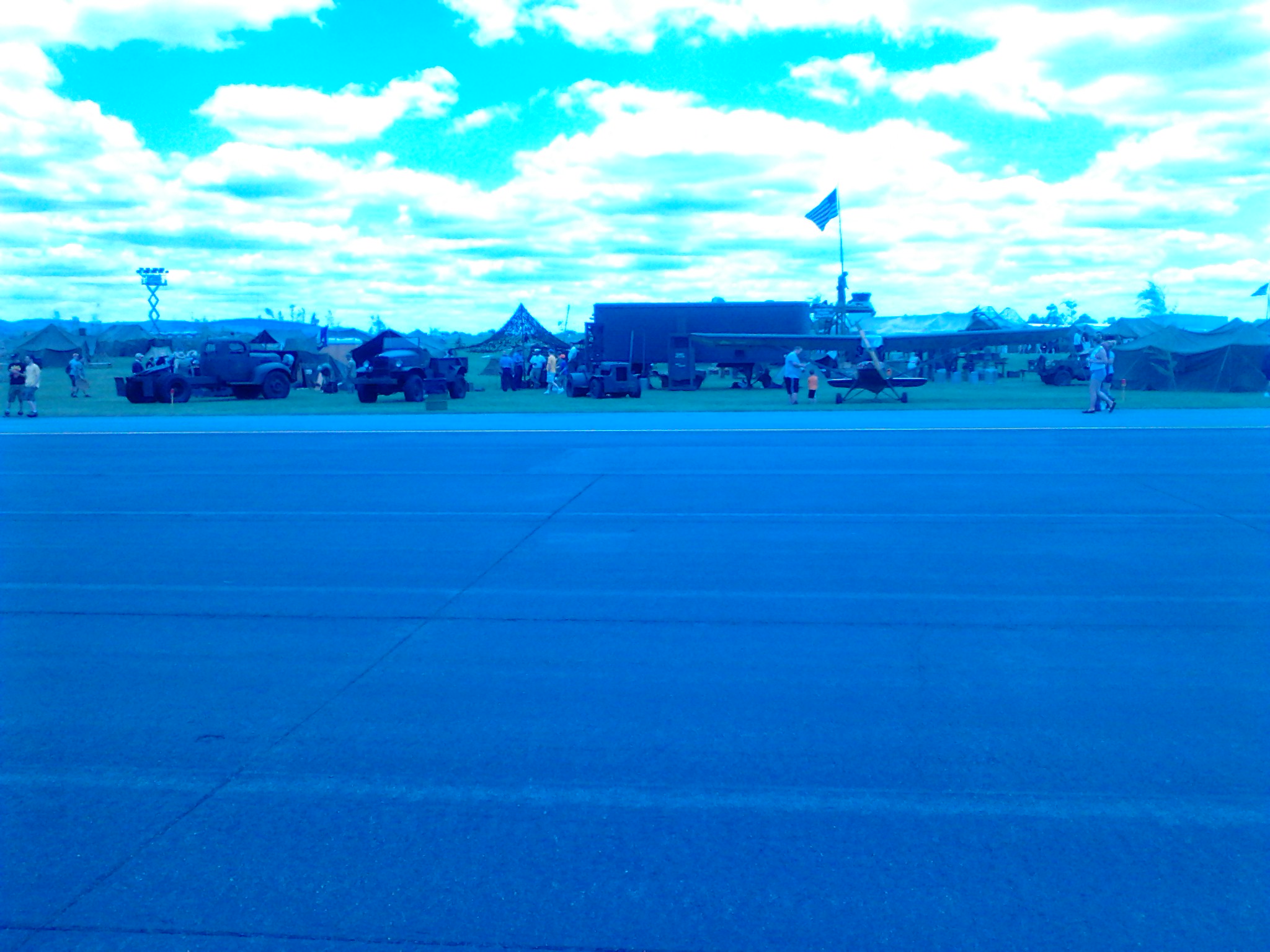
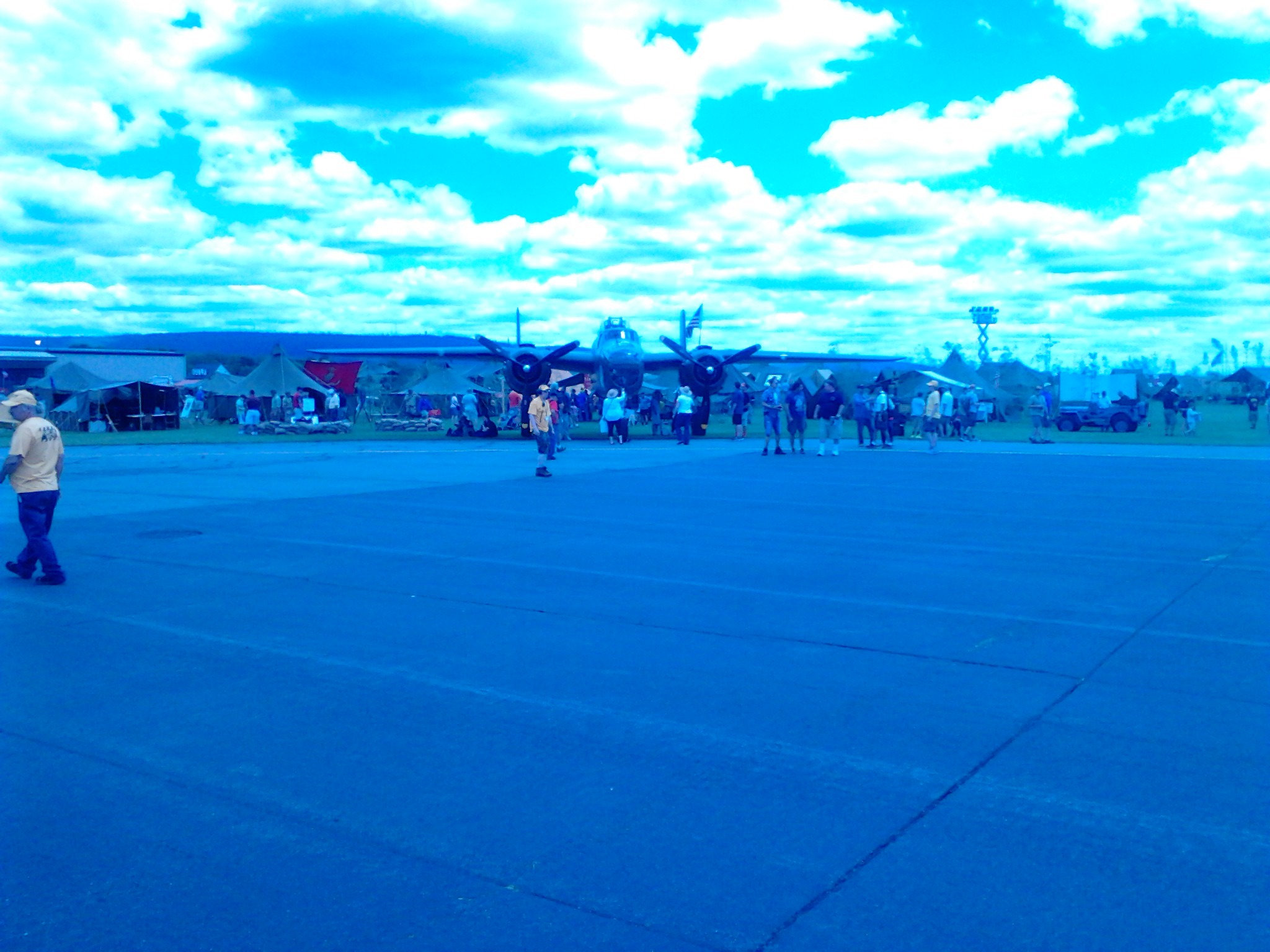
The air show draws a host of historic aircraft, trainers, fighters, bombers and cargo planes, all of them having played an important role in winning the war. In addition to the aircraft are hundreds of reenactors representing America’s army and navy as well as the soldiers of England, Germany, Japan and Russia. These troops bring along over 100 military and civilian vehicles representing the era.
In attendance are veterans, some famous and some that just did their job and want to share their experiences. I enjoy being around these men and women who risked so much in a time when the enemy was clearly defined and the reasons for the conflict beyond doubt.
In addition to the veterans drawn to the show as speakers, a number of them also are among the spectators. Testifying to this is the size of the handicapped parking area to make it as easy as possible for the elderly to attend and the staff who offer all the respect and aid they can for these cherished individuals. I never miss the opportunity to shake the hand of these elderly heroes and thank them for their service.
This past weekend, on the morning of June 6th, I was helping a speaker to where he wanted to go and noticed his baseball cap which displayed the slogan, B-26 bomber pilot. I asked him what he was doing 70 years ago on this day and he said he was dropping bombs on Cherbourg, France in support of the landing.
At the entry gate another gentleman made his way toward me, short and hobbling along using a cane. He was 90 and was a soldier there on D Day. I also had the opportunity to shake the hand of a veteran of The Battle of the Bulge. All these encounters are very special to me.
Over the years I have met some impressive individuals whose lives were changed forever by a time requiring unbelievable dedication and personal sacrifice. I cherish the opportunity to talk to these individuals who participated in a time which cannot be truly appreciated unless you were there. As the years go by, fewer and fewer veterans remain to tell their stories, to remind us of the price paid so that we are able to enjoy the life we live.
Here are some photos from the show.

C-46 COMMANDO

P-47D THUNDERBOLT

ENCAMPMENTS
 Walttriznastories's Blog