POEMS AND FLEETING THOUGHTS: OLD BOOKS
My old books,
Some two hundred years
Have little value
Except to me,
I wonder at their owners,
Readers long gone.
Gazing into a future
Unknown,
With my words
Hundreds of years gone
Cause the same ponder
Of a lover of books.
POEMS AND FLEETING THOUGHTS: THE COMING STORM
As I look out the window, the darkened sky predicts the approaching storm. The remnants of the last weather event are nearly gone, but no one is sure of the power of this one. Here are my thoughts while I await.
A pregnant sky looms,
Soon the landscape
Will change.
Altered by nature’s course,
Solitude created.
SCIENCE FICTION AND ROMANCE
WAR OF THE WORLDS
For my blog, I don’t write long pieces. I want to make my point and hold my readers’ attention. (Notice I use the plural, perhaps wishful thinking.) Not boring those reading my words.
This may gain your attention. The entry following this discusses a story of haunting romance, a story captivating me most of my life, along with classic science fiction.
I seldom watch movies more than once, but there are exceptions. Every chance I get I watch War of the Worlds – the original starring Gene Barry. For those who may have missed it, he also appeared for a moment at the end of the remake starring Tom Cruise. In some respects the remake has details reflecting H. G. Wells’ classic novel closer to the original movie. Let me discuss these comments in more detail.
The original, made in the 1950’s, scared the hell out of me when I was a kid. The way the suspense builds is magnificent. Unfortunately, after multiple viewings, I have found some incidents which make little sense. For one, when to original ship lands it is too hot to approach, yet when Gene Barry, and his almost girlfriend use the wooden farm and another ship lands destroying part of the house, the structure does not catch fire. Also, for the act which finally results in the death of the Martians is that they venture into a new world without any protective gear. Would a civilization traveling through space take that chance? Maybe, if you enjoy something, you should not revisit it multiple time, and keeping the love alive.
Now for the remake starring Tom Cruise. The weaknesses are strong, yet also keep true to the book.
If you watch the movie you may remember when Cruise and his daughter are trapped in a cellar with a character played by Tim Robbins. I could wrong about it being Robbins. I’ve been wrong before. I believe the character Robbins represents is a minister who is killed by the protagonist in the book. This act of murder is hinted strongly in the movie. But before this event, Robbins tells Cruise the belief is that the Martian machines were buried on the Earth a million years ago. I should mention that the Martians come to Earth by way of lightning strikes to power up their machines. Here comes the ‘give me a break’. It’s like burying a Model T, and in the meantime, your society develops spacecraft able to travel twice the speed of light. Yet, to save your civilization, you use the Model T. Don’t you think that the Martians would have used technology which currently existed?
To the remakes credit, they do depict the Martian’s machines closer in the book than what the original movie. But overall, I feel the original movie is the best.
Now onto the romance.
POEMS AND FLEETING THOUGHTS: THE SERENE
I envy serene church goers
Never doubting, never questioning
What they’re told
Oblivious of the deeper truth
They fit into the mold.
POEMS AND FLEETING THOUGHTS: PAST GLORY
As I age
Past small accomplishments
Thought meaningless
Take on new life.
POEMS AND FLEETING THOUGHTS: AMMUNITION
They buy a mass the deadly rounds
And no one seems to notice
The anger deep within their eyes
Mass death is in their purpose.
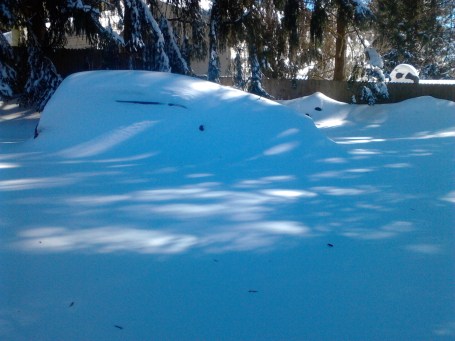
BLIZZARD’S RESULTS
Here in West Chester, PA we recorded a snowfall of 26 inches. Thought I’d share an image of my car.
Jpeg
POEMS AND RANDOM THOUGHTS: SNOW
I wrote this poem some years ago. I drag it out every winter at the appropriate time. for those of us on the East Coast, this is the right time.
This poem was inspired by Edgar Allan Poe’s, The Bells.
THE SNOW
See the delicate snowflakes fall,
Falling, falling, falling.
Whitening the earth, awaiting below,
Falling, falling, falling.
See the mounds of glittering white,
Building, building, building.
As they hide the ground from sight,
Building, building, building.
See the ceaseless falling snow,
Falling, falling, falling.
Will it stop, no one quite knows,
Falling, falling, falling.
See the drifts accumulate,
Building, building, building.
My longing for spring will no longer wait,
Building, building, building.
SEE THE DAMNED WHITE BLANKET GROW,
HIDING, HIDING, HIDING.
MY CAR, MY LAWN, ALL I KNOW,
HIDING, HIDING, HIDING.
SEE MY MADNESS, MY URGE TO KILL,
GROWING, GROWING, GROWING,
CROSS MY PATH, AND I’LL DO YOU ILL,
SMILING, SMILING, SMILING.
POEMS AND RANDOM THOUGTS: SNOWI wrote this poem some years ago. Every winter since, I drag it out of the right time. For those of us on the East Coast, now is the right time. This poem was inspired by Edgar Allan Poe’s, The Bells. THE SNOW See the delicate snowflakes fall, Falling, falling, falling. Whitening the earth, awaiting below, Falling, falling, falling. See the mounds of glittering white, Building, building, building. As they hide the ground from sight, Building, building, building. See the ceaseless falling snow, Falling, falling, falling. Will it stop, no one quite knows, Falling, falling, falling. See the drifts accumulate, Building, building, building. My longing for spring will no longer wait, Building, building, building. SEE THE DAMNED WHITE BLANKET GROW, HIDING, HIDING, HIDING. MY CAR, MY LAWN, ALL I KNOW, HIDING, HIDING, HIDING. SEE MY MADNESS, MY URGE TO KILL, GROWING, GROWING, GROWING, CROSS MY PATH, AND I’LL DO YOU ILL, SMILING, SMILING, SMILING. I wrote this poem some years ago. Every winter since, I drag it out of the right time. For those of us on the East Coast, now is the right time. This poem was inspired by Edgar Allan Poe’s, The Bells. THE SNOW See the delicate snowflakes fall, Falling, falling, falling. Whitening the earth, awaiting below, Falling, falling, falling. See the mounds of glittering white, Building, building, building. As they hide the ground from sight, Building, building, building. See the ceaseless falling snow, Falling, falling, falling. Will it stop, no one quite knows, Falling, falling, falling. See the drifts accumulate, Building, building, building. My longing for spring will no longer wait, Building, building, building. SEE THE DAMNED WHITE BLANKET GROW, HIDING, HIDING, HIDING. MY CAR, MY LAWN, ALL I KNOW, HIDING, HIDING, HIDING. SEE MY MADNESS, MY URGE TO KILL, GROWING, GROWING, GROWING, CROSS MY PATH, AND I’LL DO YOU ILL, SMILING, SMILING, SMILING.
I wrote this poem some years ago.
Every winter since, I drag it out of the right time.
For those of us on the East Coast, now is the right time.
This poem was inspired by Edgar Allan Poe’s, The Bells.
THE SNOW
See the delicate snowflakes fall,
Falling, falling, falling.
Whitening the earth, awaiting below,
Falling, falling, falling.
See the mounds of glittering white,
Building, building, building.
As they hide the ground from sight,
Building, building, building.
See the ceaseless falling snow,
Falling, falling, falling.
Will it stop, no one quite knows,
Falling, falling, falling.
See the drifts accumulate,
Building, building, building.
My longing for spring will no longer wait,
Building, building, building.
SEE THE DAMNED WHITE BLANKET GROW,
HIDING, HIDING, HIDING.
MY CAR, MY LAWN, ALL I KNOW,
HIDING, HIDING, HIDING.
SEE MY MADNESS, MY URGE TO KILL,
GROWING, GROWING, GROWING,
CROSS MY PATH, AND I’LL DO YOU ILL,
SMILING, SMILING, SMILING.

